

Mie Scattering
FSOSummary
Mie Scattering describes the scattering of an electromagnetic plane wave such as an RF or optical signal by a homogenous sphere, such as a dust particle in the atmosphere. Unlike Rayleigh scattering, where the particle size is much smaller than that of the radiation, Mie scattering occurs when the size of the particle is roughly the same or larger as the wavelength of the signal.
Unlike Rayleigh scattering, where light is scattered almost equally in all directions, Mie scattering is mostly scattered forward, which can cause scattered photons to still reach the receiver but from an unexpected path, potentially causing timing issues or interference.
what type of scattering will mostly occur can be determined by finding the dimensionless size parameter (x) of the interaction between the particle and wavelength, where is the particle’s radius, and
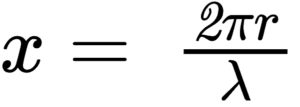
When x is less than 1 Rayleigh scattering occurs, and when x is greater than 50 the laws of geometric optics (reflection, refraction, and diffraction) applies. Mie scattering typically occurs in the sizes in between.
Relevance to FSO communications
In the near-Infrared spectrum most FSO systems operate in, the most significant source of Mie scattering generation is atmospheric aerosols, such as fog and haze which are roughly 1 to 10 µm, roughly the same size as the wavelength of a near infrared laser. Unlike Rayleigh scattering, which is strongly inversely proportional to the wavelength, there is less of reducing effect with Mie scattering. as a result increasing laser power or changing wavelength is less effective at overcoming atmospheric fog.
Relevance to RF and Millimeter Wave Communications
In typical RF (<6Ghz) communications, most atmospheric particles are too small for scattering to occur. However as mmWave and Terahertz communications which use smaller wavelengths become more popular, issues can begin to arise. Raindrops can cause Mie scattering at frequencies greater than 10Ghz, as well as heavy snow and hail.
References
Nave, R. “Blue Sky and Rayleigh Scattering.” HyperPhysics, Georgia State University.
http://hyperphysics.phy-astr.gsu.edu/hbase/atmos/blusky.html#c3
Bohren, C. F., & Huffman, D. R. Absorption and Scattering of Light by Small Particles.
https://staff.cs.manchester.ac.uk/~fumie/internal/scattering.pdf